
Mounting media – Protect your signal, support your imaging
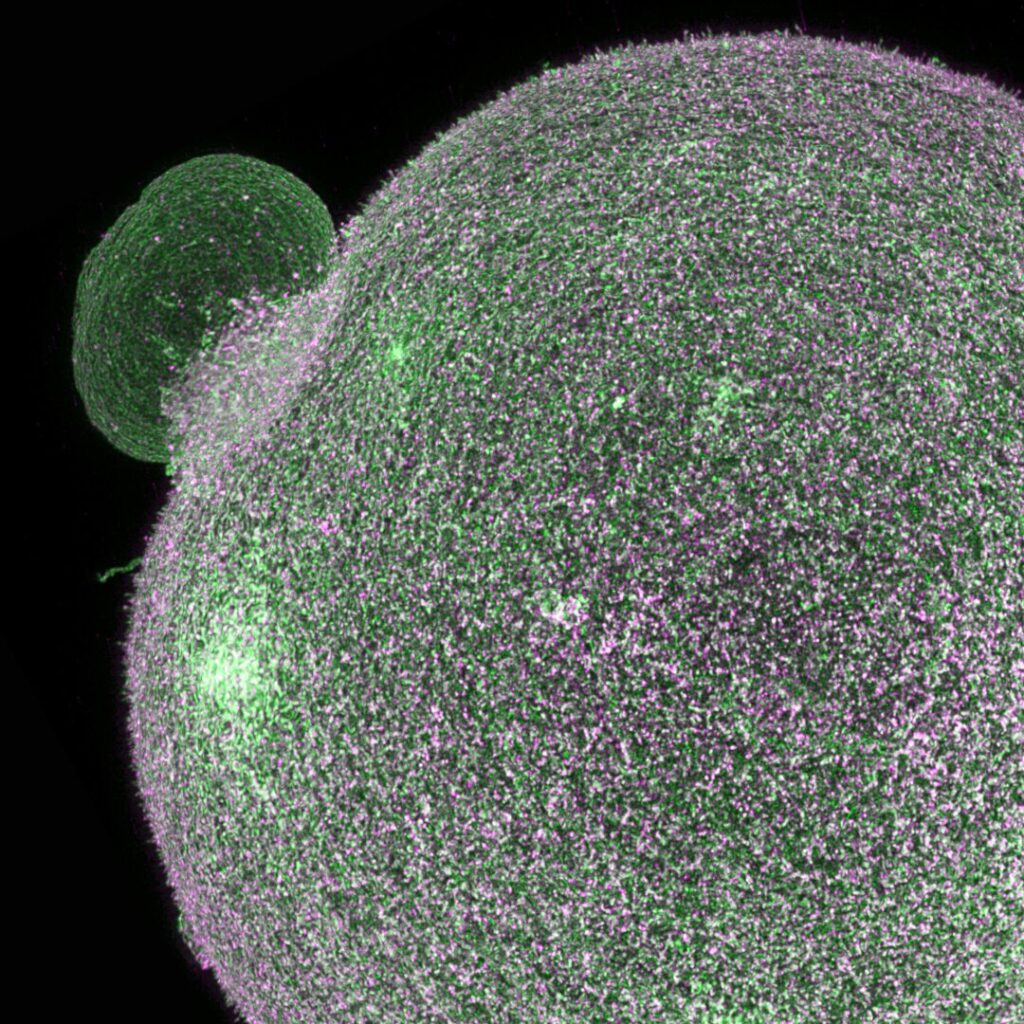
This 3D STED image shows the full structure of a mouse oocyte, labelled with two surface proteins.
Juno (green) and CD9 (magenta) highlight fine microvilli across the oocyte membrane.
Used materials: mounting medium AD-MOUNT C, mounting spacers AD-SEAL.
Biological samples distort light.
Cells and tissues are optically inhomogeneous—unlike glass or water, they bend light unevenly. When the refractive index of the sample doesn’t match its surroundings, light paths become distorted. The result: blurred images, reduced contrast, and unwanted halos that obscure fine detail.
Mounting media make images sharp and stable.
A good mounting medium penetrates deep into the sample and optically “levels out” these differences. It minimizes refractive index mismatch to improve clarity and resolution. At the same time, it protects fluorescent dyes from photobleaching and helps preserve signal intensity—so your sample stays bright and usable even after long-term storage at 4 °C.
For best results, combine with mounting spacers.
They help control sample thickness, prevent compression, and ensure consistent imaging conditions. [Learn more →]
Want to know more?
See the greatest achievement:
3D STED image of entire mouse oocyte
Learn how the sample preparation allows incredibly clear super-resolution imaging deep in the specimen.
Or download summarized bleaching assay as a PDF
Watch our short video protocol:
Mounting procedure
When selecting mounting media, you can opt for a universal hardening medium like AD-MOUNT H, ideal for those who prioritize easy and fast handling without specific requirements for preserving volumetric structure. Hardening media also effectively stabilize non-covalently bound dyes, such as Phalloidin. For more delicate applications, a non-hardening medium like AD-MOUNT F offers gentle mounting, ensuring precise preservation of biological volume and preventing cell flattening.
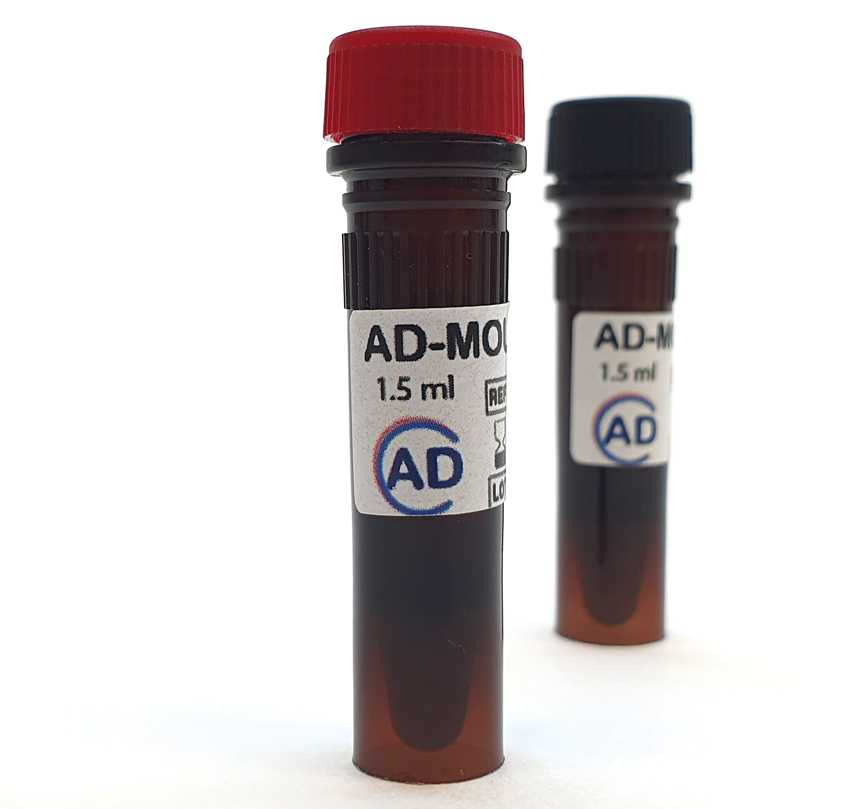
If your focus is on outstanding stabilization of synthetic fluorophores and preventing photobleaching, AD-MOUNT S provides anti-fade properties, though it may not be optimal for protein expression studies. For advanced super-resolution techniques, AD-MOUNT C is the perfect choice, offering a glass-like refractive index, exceptional stabilizing effects, and easy-clearing properties, tailored for the most precise imaging requirements.
Universal Application
Refractive index: 1.45
Hardening
All fluorophores
Universal hardening mounting medium for all fluorophore types. It offers long term stabilization of structures (like phalloidin-stained actin), dyes, minimizing photo-bleaching and fluorescence fading.
Designed for long storage of samples.
Universal Application
Refractive index: 1.45
Non-hardening
All fluorophores
Universal mounting medium accommodates a wide-range of fluorophore types. It offers optimized photo-bleaching and fluorescence fading, effectively preserving an integrity and a shape of biological structures.
Designed for long storage of samples.
Superior Stability
Refractive index: 1.47
Non-hardening
Synthetic dyes
Superior Stability mounting medium ensures robust stabilization of fluorescence signal, minimizes photo bleaching in all commonly used synthetic dyes. Preserves the integrity and shape of biological structures.
Designed for long storage of samples.
Clear view
Refractive index: 1.518
Non-hardening
Synthetic dyes
Specifically formulated for high- and super-resolution microscopy. High refractive index, exceptional clearing capabilities, and fluorescence signal stabilization effect. Suitable for commonly used synthetic dyes, but not suitable for expressions and SiR.
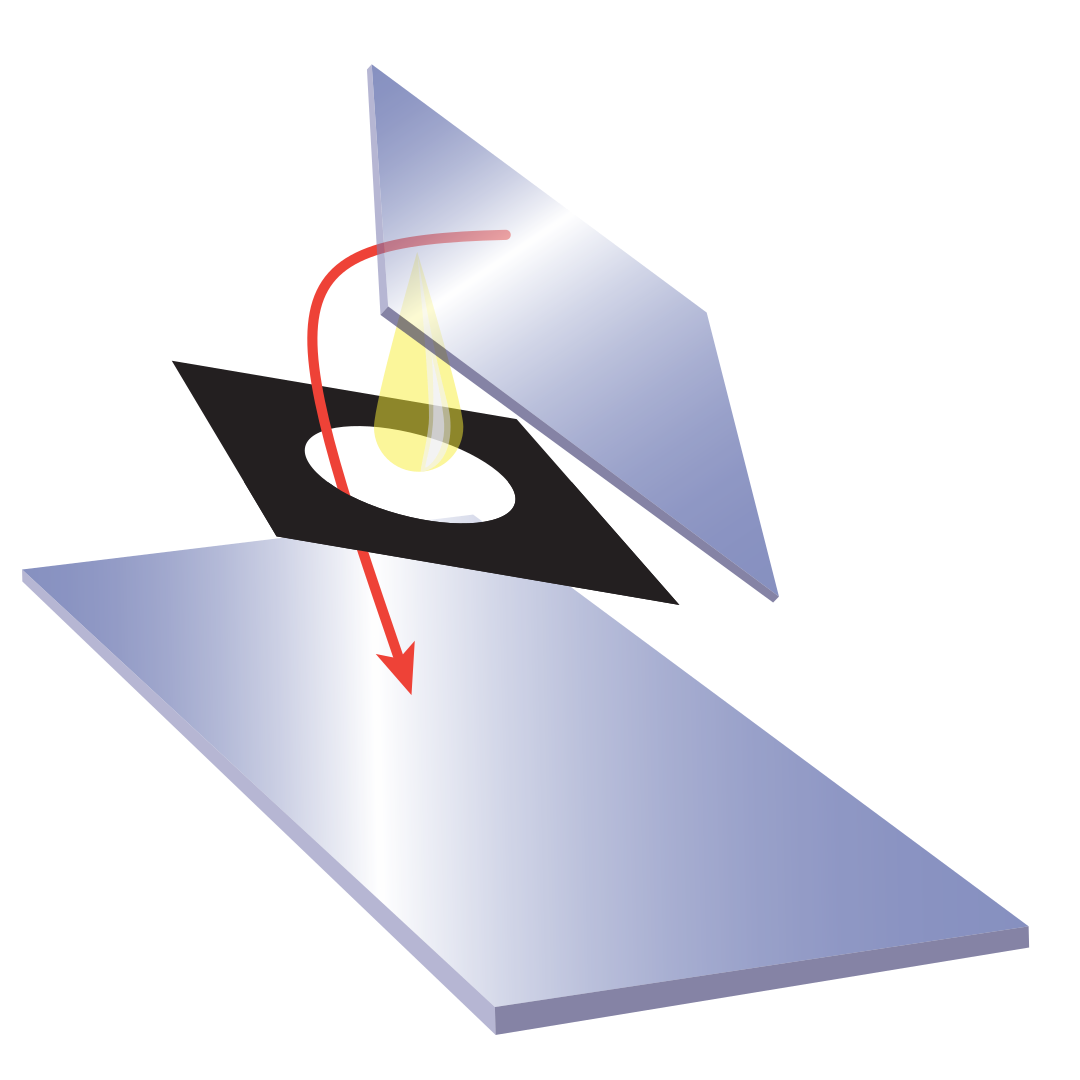
Mounting SPACERS.
For non-hardening mounting media.
For non-hardening mounting media, the use of mounting spacers is crucial to maintaining the natural shape and volume of biological samples. Spacers create a controlled gap between the cover slip and the sample, preventing unwanted flattening and preserving delicate structures. This ensures that soft tissues and cellular formations remain intact, providing optimal clarity during imaging. By using spacers in combination with non-hardening media, you can achieve more accurate and reliable results in even the most advanced microscopy techniques.